Humane wildlife removal differs entirely from generic pest extermination. Rather than dispersing rodenticide baits that risk domestic pets and leave animals to decay behind drywall, humane eviction uses the animal's…
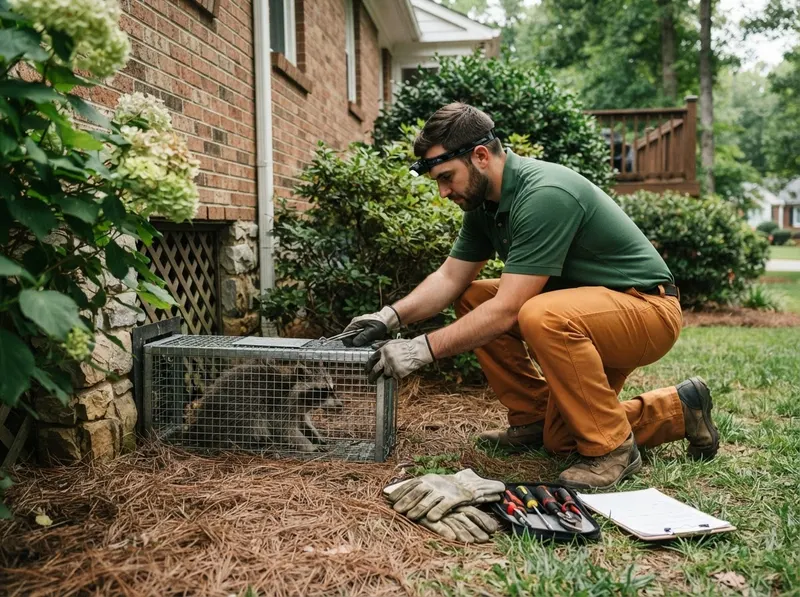
Humane wildlife removal differs entirely from generic pest extermination. Rather than dispersing rodenticide baits that risk domestic pets and leave animals to decay behind drywall, humane eviction uses the animal's natural foraging patterns to permanently clear the building. Technicians identify active entry runs along the roofline, install non-lethal one-way exclusion doors, and secure all secondary gaps with 16-gauge galvanized steel hardware cloth. Animals exit safely to find water and food but find re-entry physically barred, avoiding animal suffering and indoor biohazards.
Charlotte properties experience distinct wildlife pressures tied to local canopy density and architecture. In historic neighborhoods like Myers Park, Dilworth, and Elizabeth, mature willow oaks overhang 1920s slate and cedar shakes, allowing Eastern gray squirrels to gnaw through fascia boards and unshielded louvered dormer vents. Further south in Ballantyne and Cotswold, suburban expansions bordering McAlpine Creek often push mother raccoons into uncapped brick chimney flues and sub-floor crawl spaces during spring birthing seasons. Near wooded corridors around University City and the UNC Charlotte Botanical Gardens, brown bats frequently roost behind siding gaps as narrow as 3/8 inch.
Deciding on the correct mitigation method requires evaluating the building's architecture against active animal nesting cycles. When juvenile litters are present between March and June, direct exclusion is paced to ensure offspring are fully mobile before exit doors are installed, preventing maternal separation inside wall voids. If property owners face lightweight attic noise during daylight, gray squirrels are the likely culprit; nighttime ceiling thumps and heavy insulation disruption indicate raccoons or opossums. Step one involves an exhaustive on-site exterior audit of soffits, ridge vents, and crawl space foundations. Step two installs heavy-duty one-way funnels over the primary run while reinforcing adjacent vulnerabilities with masonry screws. Step three removes the eviction devices after 5 to 7 days of verified inactivity, followed by permanent metal flashing and non-toxic enzymatic odor neutralization to prevent return scent-tracking.
Every job gets a firm, written price after a free on-site visit.
Tell us about your humane wildlife removal job in Charlotte and we'll send a clear, written quote, usually the same day.
 Willow Ridge Pest Control