Subterranean termites nest underground and rely on ambient soil moisture, making the damp crawlspaces of historic bungalows in Dilworth and Elizabeth prime targets during the humid spring swarming season between March…
Subterranean termites nest underground and rely on ambient soil moisture, making the damp crawlspaces of historic bungalows in Dilworth and Elizabeth prime targets during the humid spring swarming season between March and May. Left unchecked, a single colony of 300,000 workers hollows out pine floor joists and wall studs behind drywall without showing surface damage. Unlike drywood termites that live entirely within structural timber, subterranean species build earthen mud shelter tubes over masonry foundation walls to reach wood. If a homeowner spots mud tubes along the crawlspace wall of a Cotswold residence, direct liquid termiticide trenching creates an invisible treated zone that worker termites unknowingly carry back to the central nest, transferring the active ingredient throughout the colony within 30 to 90 days. If the property sits on a monolithic concrete slab in modern Ballantyne developments, external bait stations installed flush with the turf every 10 to 15 feet intercept foraging workers before they discover plumbing penetrations under the slab.
A common misunderstanding is confusing winged subterranean termite swarmers with flying ants: termites feature straight antennae, broad waists, and four equally sized wings that shed quickly on windowsills, whereas ants have pinched waists and uneven wing pairs. Liquid soil barrier treatments provide immediate perimeter saturation around foundation footings, whereas baiting networks suit properties adjacent to sensitive water features or sprawling garden beds near Freedom Park. The operational trade-off centers on initial disruption versus time-to-elimination: perimeter trenching requires digging a 6-inch-wide trench along the exterior foundation perimeter and drilling through attached patio slabs, yet it halts active structural entry immediately; exterior baiting preserves landscaping untouched but relies on natural foraging discovery cycles to deliver colony collapse over several weeks.
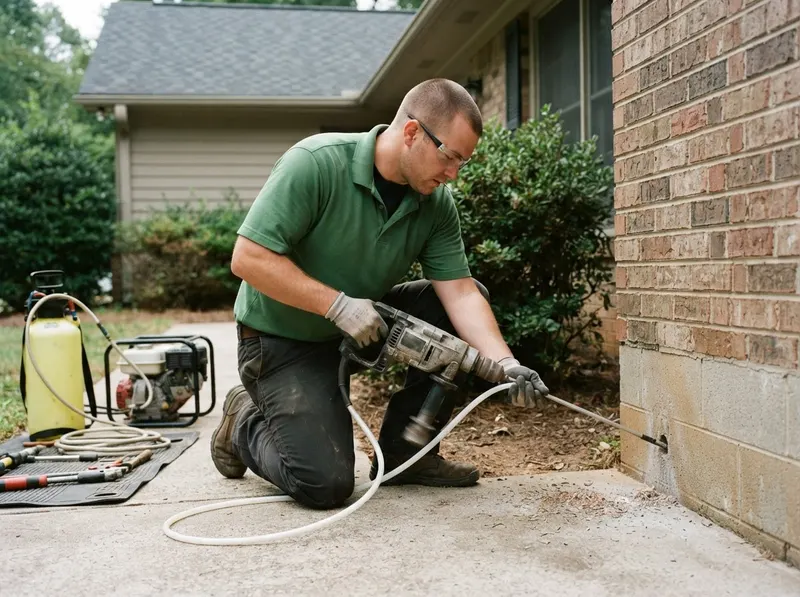
Treatment execution follows three distinct technical steps to ensure total barrier integrity. First, technicians excavate a continuous 6-inch by 6-inch trench directly into the native soil along exterior foundation walls, rodding liquid termiticide down to the top of the concrete footing at an EPA-approved rate of 4 gallons per 10 linear feet. Second, for crawlspace foundations common throughout Myers Park and Plaza Midwood, technicians rod treat the interior soil along perimeter stem walls and individual masonry piers supporting central main beams. Third, technicians seal masonry injection access holes with hydraulic cement and position non-toxic cellulose bait monitors around the outer perimeter to intercept satellite colonies without blanketing family living areas in unnecessary residual chemicals.
Every job gets a firm, written price after a free on-site visit.
Tell us about your subterranean termite treatment job in Charlotte and we'll send a clear, written quote, usually the same day.
 Willow Ridge Pest Control